Google은 AI 개발 플랫폼 Google Antigravity와 단백질 기능 예측 모델 ProtNLM을 활용해 새로운 항균 펩타이드 후보를 찾는 과정을 지원합니다. 호흡기 감염 병원체에 효과가 있을 것으로 예측된 후보를 찾아냈으며, 현재 실험실 검증이 진행 중이라고 밝혔습니다.
보도자료 · 한국어 번역업로드
글자 크기
항균제 내성이 늘고 있어 새로운 항생제가 시급히 필요합니다. 하지만 새로운 치료제를 찾는 일은 대개 시간이 오래 걸리고 많은 노동이 필요합니다. Google의 AI 에이전트 기반 개발 플랫폼인 Google Antigravity를 사용하면 이 과정을 더 쉽게 진행할 수 있습니다.
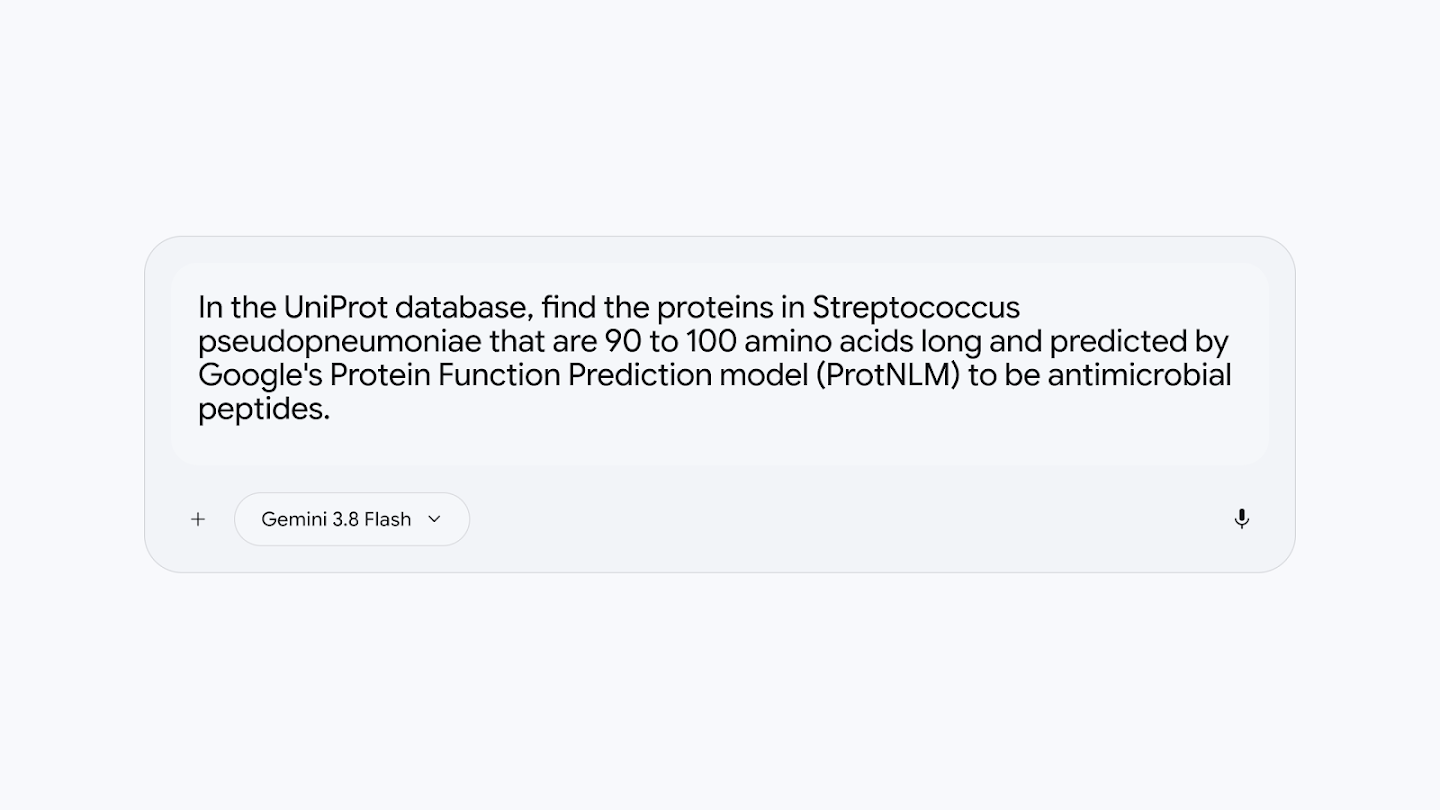
Navigating a vast search space:The agent queries the database and filters millions of entries down to a handful of candidates worthy of attention. Here, the agent finds a bacteriocin (Uniprot ID: A0A0U0D591) with a length of 97 amino acids from the Lactococcin 972 family.출처: Google DeepMind 블로그 · Google DeepMind
Google Antigravity는 생물학자들이 유망한 표적을 빠르게 찾고, 구조를 평가하고, 우선순위를 정하도록 돕는 과학 연구 환경을 제공합니다. 여러 데이터베이스를 오가며 따로 진행하던 탐색 과정을 한 번의 작업으로 줄여줍니다. 또한 아미노산 서열을 바탕으로 생물학적 기능을 예측하는 모델 ProtNLM을 사용해 UniProt 데이터베이스의 기능이 아직 밝혀지지 않은 단백질 수백만 개를 살펴볼 수 있도록 지원합니다.
이 기술 안내에서는 생물학자들이 Google Antigravity를 사용해 새로운 항균 펩타이드 후보를 찾아낸 과정을 소개합니다. 이 후보는 호흡기 감염을 일으키는 병원체에 효과가 있을 것으로 예측됐습니다. 여기서 확인한 주요 후보는 현재 실험실 검증을 받고 있습니다.
새로운 항균 펩타이드 찾기
항균제 내성 증가는 오늘날 세계 보건에서 가장 시급한 위기 가운데 하나입니다. 2050년에는 전 세계에서 매년 약 1,000만 명이 이로 인해 사망할 수 있다는 추정도 있습니다. 이를 막으려면 새로운 치료제를 찾아야 합니다. 항균 펩타이드(AMP), 특히 박테리오신은 기존 항생제를 대체할 유망한 선택지입니다. 이 물질은 경쟁 관계에 있는 박테리아의 세포 외피부터 세포 안의 필수 작동 장치까지, 근본적인 취약점을 겨냥하도록 자연적으로 진화했습니다. 따라서 병원체가 내성을 얻기 어렵습니다.
유전체와 메타유전체 염기서열 분석이 급증하면서 전 세계 데이터베이스에는 자연에서 나온 아미노산 서열이 수십억 개 쌓였습니다. 이 자연 서열 데이터에서는 세계적으로 쓰이는 박테리오신인 니신(Nisin)이 발견됐습니다. 최근에는 유전체 분석으로 다로박틴(Darobactin), 다이노박틴(Dynobactin), 라리오시딘(Lariocidin) 같은 물질도 찾아냈습니다.
하지만 많은 서열은 단백질 데이터베이스의 주석이 달리지 않은 ‘암흑 물질’ 속에 남아 있습니다. 알려진 단백질과 비슷하지 않아 기능이 밝혀지지 않았기 때문입니다. 단백질 서열과 기능 정보를 제공하는 세계 최대 규모의 공개 데이터베이스인 UniProt에도 기능을 알 수 없는 서열이 수백만 개 있습니다. 이 서열들은 유전체 염기서열 분석 프로젝트에서 직접 옮겨온 것입니다.
이 간극을 메우기 위해 Google은 ProtNLM(Protein Natural Language Model)을 개발했습니다. 아미노산 서열에 담긴 진화의 ‘문법’을 직접 읽도록 학습한 딥러닝 모델입니다. 이 모델은 가공되지 않은 단백질 서열만으로 생물학적 기능을 예측할 수 있습니다. 이를 통해 UniProt에 이름만 없던 서열 수백만 개에 신뢰도 높은 기능 정보를 추가합니다.
사람과 AI의 협력
과학적 발견은 대개 한 번에 끝나지 않습니다. 실제로 쓸 수 있는 단백질 후보를 찾으려면 연구자의 직관과 반복적인 검토가 필요하고, 새로 얻은 실험 근거도 반영해야 합니다. Antigravity에서 연구자와 AI 에이전트는 먼저 구체적인 생물학 목표를 정합니다. 예를 들어 Streptococcus pseudopneumoniae에서 새로운 항균 펩타이드를 찾고 컴퓨터 분석으로 검증하는 것입니다. 여러 차례 대화하는 동안 연구자는 어떤 질문을 할지, 어떤 근거를 모을지 정하며 연구 방향을 이끕니다. 에이전트는 여러 데이터베이스를 연결하고, 구조를 분석하고, 관련 문헌을 종합하는 복잡한 작업을 맡습니다.
이 안내에서 찾은 후보는 구조와 유전체 자료가 뒷받침하는 생물학적으로 타당한 물질입니다. 하지만 실제 실험실에서 검증해야 합니다. 이 작업의 의미는 일상적인 생물학 연구의 진입 장벽을 크게 낮춘다는 데 있습니다. 여러 데이터베이스를 오가며 며칠씩 하던 선별 작업을 한 번의 협력 세션으로 바꿉니다. 이번에는 Streptococcus pseudopneumoniae의 특정 아미노산 길이에 초점을 맞췄지만, 연구자는 새로운 필터 조건을 추가하거나 다른 길이의 서열을 살펴보고 우선순위가 높은 다른 병원체를 대상으로 삼을 수 있습니다. 사람과 함께 살아가는 미생물에서 환경 미생물 등으로 탐색 범위를 넓히면, 과학자는 에이전트가 UniProt을 살펴보도록 이끌어 대규모로 새로운 항균 펩타이드 후보를 찾을 수 있습니다.
함께 쓰는 3D 화면으로 대화형 협업
단백질의 3차원 구조는 생물학적 기능을 이해하는 데 도움이 됩니다. 따라서 후보 단백질이 공간에서 어떤 형태로 접히는지 예측해 살펴보는 일이 중요합니다. 이 과정을 하나의 작업 공간에서 처음부터 끝까지 진행할 수 있도록, Antigravity 안에 3D 시각화 도구인 생체분자 구조 뷰어(Biomolecular Structure Viewer)를 선보입니다.
연구자와 에이전트는 같은 시각 자료를 보며 함께 작업합니다. 에이전트는 AlphaFold Database나 연구자가 직접 만든 예측 자료에서 구조를 가져와 뷰어를 실시간으로 조작할 수 있습니다. 예를 들어 중요한 기능 부위를 강조해 자신의 가설을 눈으로 보여줄 수 있습니다. 반대로 연구자가 특정 잔기를 강조하거나 결합 부위에 메모를 고정하면, 그 정보도 에이전트에 전달됩니다. 연구자는 3D 화면에서 관심 부위를 표시한 뒤 “이 β-가닥이 Lipid II 결합에 어떤 영향을 줄 수 있나요?”라고 물을 수 있습니다. 그러면 에이전트는 연구자가 보고 있는 정확한 구조를 바탕으로 바로 분석할 수 있습니다.
과학적 발견 가속
과거에는 위와 같은 연구를 하려면 서로 연결되지 않은 여러 전문 소프트웨어를 써야 했습니다. 데이터베이스를 검색하는 코드를 직접 작성하고, 파일을 3D 모델링 프로그램으로 수동으로 옮겨야 했습니다. 서로 연결되지 않은 유전체 분석 도구를 관리하고, 실험실 검사를 설계할 여러 전문가와 협업해야 했습니다. 실제 실험실 검증에는 많은 자원이 들기 때문에 처음부터 신뢰도가 가장 높은 후보만 추리는 일이 중요합니다. Google Antigravity를 사용하면 연구자는 방대한 생물학 데이터에서 효율적으로 탐색할 수 있습니다. 분야에 특화된 모델이 제공하는 정확한 단백질 기능 예측도 활용할 수 있습니다.
Google Antigravity는 이 모든 과학적 추론 과정을 한곳에서 진행합니다. 이를 통해 과학자는 질 높은 가설을 평가하고 실험실에서 실험을 수행하며 연구 과제를 해결하는 데 더 많은 시간을 쓸 수 있습니다.
감사의 말
다음 팀원들의 기여에 감사드립니다. Maria Gabriela Cardoso, Victoria Johnston, Lexi Walker, Gena Hong, James King, Richard Green, Filip Radlinski, Artem Sobolev, Michael V. LeVine, Ruijie K. Zhang, Zachary Wu, Luca Schulz, Amy Danson, Tristan Oliver Kwan, Ryan Krueger, Oleg Kovalevskiy, Doug Fritz, Yunhan Xu, Sebastian Nowozin
영어 원문
Accelerating the search for antimicrobial peptides with Google Antigravity
New antibiotics are urgently needed to help with rising levels of antimicrobial resistance, but searching for new therapeutics is often a slow, labor-intensive process. With Google Antigravity, our agentic development platform, this process can now be made easier.
Google Antigravity provides an agentic science workbench that empowers biologists to discover, structurally evaluate, and prioritize promising targets quickly, compressing what used to be a fragmented search over multiple databases into a single session. It also helps researchers scan through millions of previously uncharacterized proteins in the UniProt database using ProtNLM, a model that predicts biological function from amino acid sequences.
This technical walkthrough shows how biologists used Google Antigravity to uncover a novel antimicrobial peptide candidate which has predicted activity against the pathogens involved in respiratory tract infections. The lead identified here is now undergoing wet-lab validation.
Finding new antimicrobial peptides
Rising antimicrobial resistance is one of the most pressing global health crises of our time and could result in an estimated 10 million annual deaths globally by 2050. To prevent this, we urgently need to discover novel therapeutics. Antimicrobial peptides (AMPs), particularly bacteriocins, offer a promising alternative to traditional antibiotics because they have naturally evolved to target fundamental vulnerabilities in competing bacteria, from cell envelopes to essential intracellular machinery, making it difficult for pathogens to develop resistance.
The exponential growth of genomic and metagenomic sequencing has populated global databases with billions of natural amino acid sequences. This pool of natural data has already produced globally used bacteriocins like Nisin, alongside recent genome-mined breakthroughs such as Darobactin, Dynobactin, and Lariocidin.
Many, however, remain locked within the unannotated "dark matter" of protein databases, with their function uncharacterized because they aren’t similar to known proteins. For example, the world's leading public resource of protein sequence and functional information, UniProt, holds millions of sequences with unknown functionality, transferred directly from genome sequencing projects.
To bridge this gap, Google developed ProtNLM (Protein Natural Language Model), a deep learning model trained to directly read the underlying evolutionary “grammar” of amino acid sequences. This allows the model to predict biological function directly from raw protein sequences, enriching millions of previously unnamed UniProt entries with high-confidence functional labels.
Collaborative intelligence
Scientific discovery is rarely a single step process; finding viable candidate proteins requires human intuition and iteration to incorporate new empirical evidence. Working in Antigravity, the researcher and AI agent begin by setting a focused biological goal: find and computationally validate novel AMPs in Streptococcus pseudopneumoniae. During an interactive, multi-turn session the researcher steers the scientific strategy, deciding which questions to ask and what evidence to collect, while the agent handles the heavy lifting of cross-database orchestration, structural analysis, and literature synthesis.
The candidate we uncover in this walkthrough represents a biologically plausible lead backed by structural and genomic evidence but it still requires wet lab validation. What makes this meaningful is how dramatically it lowers the barrier to everyday biological workflows, turning days of fragmented database triage into a single collaborative session. While this session focused on a narrow amino acid window in Streptococcus pseudopneumoniae, researchers can take the conversation in any direction, such as layering in new filtering criteria, exploring different sequence lengths, or targeting other priority pathogens. By broadening the search from human commensals to environmental microbes and beyond, scientists can guide the agent across UniProt to discover novel AMP candidates at scale.
A shared 3D canvas for interactive collaboration
A protein's 3D structure can help us understand its biological function. Examining a candidate’s predicted fold in space is key. To provide this end-to-end workflow in a single workspace, we are introducing the Biomolecular Structure Viewer, a 3D visualization tool embedded directly into Antigravity.
The researcher and agent work together over a shared visual state. As the agent retrieves structures from AlphaFold Database or the scientist’s own predictions, it can dynamically drive the viewer. For instance, it can highlight key functional regions to visually explain its hypotheses. Crucially, this awareness flows both ways: actions like highlighting specific residues or pinning notes directly onto a binding pocket are synchronised back to the agent. A researcher can simply mark a region of interest in 3D space and ask, for example, "How might this β-strand affect Lipid II binding?", allowing the agent to immediately reason over the exact structural context the scientist is looking at.
Accelerating Scientific Discovery
Historically, uncovering insights like those in the workflow demonstrated above required fragmented and specialised software: writing custom scripts to query databases, manually exporting files to 3D modelling programs, managing disconnected genomic tools and working with multiple experts to design the wet lab assays. Because wet-lab validation remains resource-intensive, narrowing the search space to only the highest-confidence leads upfront is critical. Using Google Antigravity allows researchers to navigate the vast biological search space efficiently while leveraging accurate protein function predictions from a domain-specific model.
Google Antigravity executes this end-to-end scientific reasoning in one place. This allows scientists to spend more time evaluating high-quality hypotheses, running experiments in the lab and solving research challenges.
Acknowledgements
We would like to acknowledge the contributions of the following team members: Maria Gabriela Cardoso, Victoria Johnston, Lexi Walker, Gena Hong, James King, Richard Green, Filip Radlinski, Artem Sobolev, Michael V. LeVine, Ruijie K. Zhang, Zachary Wu, Luca Schulz, Amy Danson, Tristan Oliver Kwan, Ryan Krueger, Oleg Kovalevskiy, Doug Fritz, Yunhan Xu, Sebastian Nowozin